
Object ID
2011.7.211
Object Name
Saucepan
Object Collection
Alex's Candy Shop (is part of)
Date Created
1920 – 1940
Material
Metal
Object Entities
Object Description
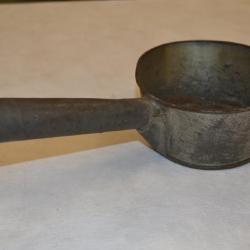
This metal saucepan is silver in color and of a medium size. It has a very basic construction with a handle. The bowl of the saucepan used to be round but is kind of bent on the left side of the handle making more of a spout type shape. The sides are straight instead of curved and the inside of the pan is a little discolored from use and age. On the outside of the pan the number 30 is indented in the side.
The handle extends from the seam of the pan and is completely circular. It tapers in towards the pan and becomes thicker as it moves away from the pan. At the verhy edge is a small metal ring that could hang the whole object. The entire pan is a little discolored and a darker rust hue in areas of greater contact with use.
The handle extends from the seam of the pan and is completely circular. It tapers in towards the pan and becomes thicker as it moves away from the pan. At the verhy edge is a small metal ring that could hang the whole object. The entire pan is a little discolored and a darker rust hue in areas of greater contact with use.
Origin
Paulina Franks' grandfather, John Rassogianis, came to Chicago in the 1890s. He began his life in the new city by peddling fruits and later, with the help of his sons Alex and George, would open a candy store. In the 1920s Paulina Franks' father Constantine became a part of the family business and the store was able to prosper. When the second business closed Paulina Rassogianis chose to hold as many of the candy store's items as possible and, later, donate them to the National Hellenic Museum.
The Rassogianis family began their candy business in Chicago proper, working out of their own shop named "St. Louis Ice Cream Parlor." Eventually, the shop was closed and the Rassogianis' chose to continue their candy store venture in Berwyn, Illinois. The new shop they chose to open was named Alex's Sweet Shop.
Paulina Franks' father was a key contributor to the success of the Rassogianis candy stores. While Constantine Rassogianis was a noteworthy entrepeneur, he also had many other accomplishments. Among these was his four years of involvment in the Greek national military during World War I wherein he obtained the rank of sergeant. Also, he was a published author and poet, an experienced mandolin player, a church officer and had extensive knowledge of psalti.
This object was probably made of aluminum and mass produced which is why there are no distinguishing marks on it. The history of saucepans, an off-shoot of basic bakeware, is a type of food preparation container commonly found in a kitchen. Cookware comprises cooking vessels, such as saucepans and frying pans, intended for use on a stove or range cooktop. Bakeware comprises cooking vessels intended for use inside an oven. Metal pots are made from a narrow range of metals because pots and pans need to conduct heat well, but also need to be chemically unreactive so that they do not alter the flavor of the food. Most materials that are conductive enough to heat evenly are too reactive to use in food preparation. In some cases (copper pots, for example), a pot may be made out of a more reactive metal, and then tinned or clad with another.
The Rassogianis family began their candy business in Chicago proper, working out of their own shop named "St. Louis Ice Cream Parlor." Eventually, the shop was closed and the Rassogianis' chose to continue their candy store venture in Berwyn, Illinois. The new shop they chose to open was named Alex's Sweet Shop.
Paulina Franks' father was a key contributor to the success of the Rassogianis candy stores. While Constantine Rassogianis was a noteworthy entrepeneur, he also had many other accomplishments. Among these was his four years of involvment in the Greek national military during World War I wherein he obtained the rank of sergeant. Also, he was a published author and poet, an experienced mandolin player, a church officer and had extensive knowledge of psalti.
This object was probably made of aluminum and mass produced which is why there are no distinguishing marks on it. The history of saucepans, an off-shoot of basic bakeware, is a type of food preparation container commonly found in a kitchen. Cookware comprises cooking vessels, such as saucepans and frying pans, intended for use on a stove or range cooktop. Bakeware comprises cooking vessels intended for use inside an oven. Metal pots are made from a narrow range of metals because pots and pans need to conduct heat well, but also need to be chemically unreactive so that they do not alter the flavor of the food. Most materials that are conductive enough to heat evenly are too reactive to use in food preparation. In some cases (copper pots, for example), a pot may be made out of a more reactive metal, and then tinned or clad with another.
Rights and Reproduction
The content on this site is made available for research and education purposes only. The use of these materials may be restricted by law or the donor.
Any other use, such as exhibition, publication, or commercial use, is not allowed except by written permission in accordance with the NHM Image Rights and Reproduction Policy.
For questions on image rights and reproduction, please contact [email protected]
Any other use, such as exhibition, publication, or commercial use, is not allowed except by written permission in accordance with the NHM Image Rights and Reproduction Policy.
For questions on image rights and reproduction, please contact [email protected]
Citation
Saucepan, 1920 – 1940, Alex's Candy Shop, National Hellenic Museum, https://collections.nationalhellenicmuseum.org/Detail/objects/8709. Accessed 10/14/26.