Object ID
2005.8.27
Object Name
Painting
Date Created
1920
Measurements
24.2900200000 cm. W Image is 9.75 by 7.063 inches., Item (Overall)
Medium
Paint
Material
Wood
Object Entities
Related Items
Runner, Table, 2005.8.1
Runner, Table, 2005.8.2
Scarf, 2005.8.3
Nightgown, 2005.8.4
Slip, 2005.8.5
Scarf, 2005.8.6
Fabric, 2005.8.7
Fabric, 2005.8.8
Vestment, 2005.8.9
Vestment, 2005.8.10
Runner, Table, 2005.8.11
Vest, 2005.8.12
Slip, 2005.8.13
Slip, 2005.8.14
Fabric, 2005.8.15
Blouse, 2005.8.16
Slip, 2005.8.17
Runner, table, 2005.8.18
Fabric, 2005.8.19
Pattern, Needlework, 2005.8.20
Tablecloth, 2005.8.21
Skirt, 2005.8.22
Handkerchief, 2005.8.23
Jacket, 2005.8.24
Vest, 2005.8.25
Photograph, 2005.8.26
Icon, 2005.8.28
Print, 2005.8.29
Purse, 2005.8.30
Pot, 2005.8.31
Figurine, 2005.8.32
Buckle, Belt, 2005.8.33
Vase, Temple, 2005.8.34
Altarpiece, 2005.8.35
Runner, Table, 2005.8.2
Scarf, 2005.8.3
Nightgown, 2005.8.4
Slip, 2005.8.5
Scarf, 2005.8.6
Fabric, 2005.8.7
Fabric, 2005.8.8
Vestment, 2005.8.9
Vestment, 2005.8.10
Runner, Table, 2005.8.11
Vest, 2005.8.12
Slip, 2005.8.13
Slip, 2005.8.14
Fabric, 2005.8.15
Blouse, 2005.8.16
Slip, 2005.8.17
Runner, table, 2005.8.18
Fabric, 2005.8.19
Pattern, Needlework, 2005.8.20
Tablecloth, 2005.8.21
Skirt, 2005.8.22
Handkerchief, 2005.8.23
Jacket, 2005.8.24
Vest, 2005.8.25
Photograph, 2005.8.26
Icon, 2005.8.28
Print, 2005.8.29
Purse, 2005.8.30
Pot, 2005.8.31
Figurine, 2005.8.32
Buckle, Belt, 2005.8.33
Vase, Temple, 2005.8.34
Altarpiece, 2005.8.35
Access Points
Object Description
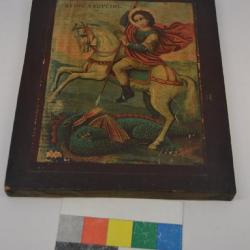
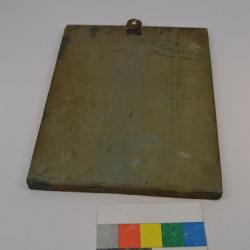
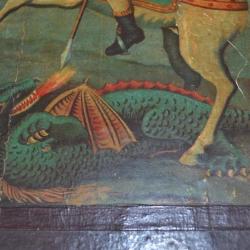
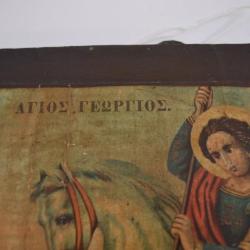
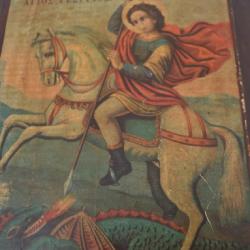
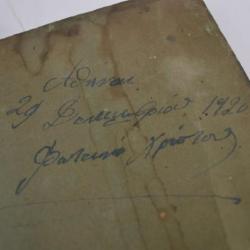
A painted wood icon with paper on the back and a metal hook for hanging. The icon has Greek text written on the back. The paper on the back is staining and cracking. The front is scuffed, the bottom left corner is chipped, scratches, and chips on the image, and vertical creases on the image. The icon is of St. George slaying a dragon. St. George is riding a white horse with a yellow and red bridle and a green saddle with stirrups. St. George holds a spear pointed at the dragon, while the dragon breathes fire. The saint is depicted wearing blue armor with a yellow cross on the front and white sleeves. There is a red fabric crossing across his chest and flowing behind him. He has brown hair and a circle around his head. He is wearing white stockings with black boots and yellow socks. The dragon is lying between the horse's rear legs and is looking up at the saint. It is green with yellow wings and a red ruff down the dragon's spine. The background is a faded green color, with a silhouette of a hill painted in the background. In the top left corner is writing which reads "Saint George" in Greek. There is a thick wooden border around the painting. The writing on the back is in Greek, with the year "1920."
Origin
Saint George and the Dragon, the story that this icon depicts, is a commonly told story that is thought to have been brought back by the Crusaders. There are two adaptions of the story. The first is that there was a dragon that made its nest near the body of water that the people of Silene (thought to possibly be modern-day Cyrene in Lybia) needed to get their water from. Daily, they would have to distract the dragon to draw water for their town. At first, they would offer a sheep, but if no sheep were available, then maidens were soon chosen from a random selection to be thrown to the dragon. One day, this random selection happened to be the princess. The monarch begged for her life to be spared, but his wish was not granted. Just as the princess prepared to be given to the dragon, then came St. George from his travels. Protected by the sign of the cross, he defeats the dragon. It is said that the people of the city of Silene then abandoned their ancestral paganism and converted to Christianity.
The other adaptation of this tale is that the dragon that is being slain in the icon, stands for a pagan cult. St. George is seen as defeating that, because of his common association with being a martyr for Christianity. After losing both of his parents as a young adult, St. George presented himself to Emperor Diocletian to apply for a career as a soldier. St. George's father had been a very loyal and admired soldier, and because of that, Emperor Diocletian welcomed St. George with open arms. He was soon promoted to be an imperial guard for the Emperor at Nicomedia. Diocletian soon ordered for all Christian soldiers to be arrested and for the other soldiers to offer a sacrifice to the Roman gods. St. George confronted Emperor Diocletian and professed his faith and his disagreement with the Emperor's decision. The Emperor, not wanting to lose one of his best soldiers, tried to get St. George to convert, but he would not. He was sentenced to torture and death and is hailed as a leader, an example of Christianity, and a martyr.
The other adaptation of this tale is that the dragon that is being slain in the icon, stands for a pagan cult. St. George is seen as defeating that, because of his common association with being a martyr for Christianity. After losing both of his parents as a young adult, St. George presented himself to Emperor Diocletian to apply for a career as a soldier. St. George's father had been a very loyal and admired soldier, and because of that, Emperor Diocletian welcomed St. George with open arms. He was soon promoted to be an imperial guard for the Emperor at Nicomedia. Diocletian soon ordered for all Christian soldiers to be arrested and for the other soldiers to offer a sacrifice to the Roman gods. St. George confronted Emperor Diocletian and professed his faith and his disagreement with the Emperor's decision. The Emperor, not wanting to lose one of his best soldiers, tried to get St. George to convert, but he would not. He was sentenced to torture and death and is hailed as a leader, an example of Christianity, and a martyr.
Rights and Reproduction
The content on this site is made available for research and education purposes only. The use of these materials may be restricted by law or the donor.
Any other use, such as exhibition, publication, or commercial use, is not allowed except by written permission in accordance with the NHM Image Rights and Reproduction Policy.
For questions on image rights and reproduction, please contact [email protected]
Any other use, such as exhibition, publication, or commercial use, is not allowed except by written permission in accordance with the NHM Image Rights and Reproduction Policy.
For questions on image rights and reproduction, please contact [email protected]
Citation
Painting, 1920, National Hellenic Museum, https://collections.nationalhellenicmuseum.org/Detail/objects/6349. Accessed 10/14/26.