Object ID
2006.19.23
Object Name
Photograph
Object Entities
Diane Frangos, Angela Gatsos Demetrakakes (is related to)
Related Items
Picture, 2006.19.78
Photograph, 2006.19.5
Photograph, 2006.19.4
Postcard, 2006.19.53
Postcard, 2006.19.75
Postcard, 2006.19.76
Postcard, 2006.19.74
Postcard, 2006.19.59
Postcard, 2006.19.58
Cutter, Noodle, 2006.19.83
Menu, 2006.19.102.B
Menu, 2006.19.102.C
Menu, 2006.19.102.D
Menu, 2006.19.102.E
Menu, 2006.19.102.F
Menu, 2006.19.102.G
Menu, 2006.19.102.H
Menu, 2006.19.102.I
Menu, 2006.19.102.J
T.S.S. OLYMPIA INFORMATION BROCHURE, 2006.19.102.K
Booklet, 2006.19.102.L
Menu, 2006.19.102.M
Menu, 2006.19.102.N
Booklet, 2006.19.102.A
Photograph, 2006.19.65
Photograph, 2006.19.47
Photograph, 2006.19.48
Photograph, 2006.19.49
Photograph, 2006.19.70
Photograph, 2006.19.19
Photograph, 2006.19.12
Photograph, 2006.19.10
Photograph, 2006.19.14
Photograph, 2006.19.2
Grinder, 2006.19.82.A
Photograph, 2006.19.20
Suitcase, 2006.19.104
Certificate, Immigration, 2006.19.101
Photograph, 2006.19.3
Suitcase, 2006.19.103
Rug, 2006.19.8.7
Grinder, 2006.19.82.B
Grinder, 2006.19.82.C
Blanket, 2006.19.84
Rug, 2006.19.85
Rug, 2006.19.86
Tablecloth, 2006.19.88
Trough, Dough, 2006.19.89
Blouse, 2006.19.90.A
Skirt, 2006.19.90.B
Cover, Pillow, 2006.19.92
Cover, Pillow, 2006.19.93
Pin, Fraternal, 2006.19.94
Coffeepot, 2006.19.95
Icon, 2006.19.96.A
Icon, 2006.19.96.B
Icon, 2006.19.96.C
Icon, 2006.19.96.D
Icon, 2006.19.96.E
Burner, Incense, 2006.19.97
Burner, Incense, 2006.19.98
Skirt, Foustanella, 2006.19.99.A
Skirt, Foustanella, 2006.19.99.B
Stocking, 2006.19.99.C.1
Stocking, 2006.19.99.C.2
Sheath, 2006.19.99.D
Scarf, 2006.19.99.E
Fez, 2006.19.99.F
Belt, 2006.19.99.G
Belt, 2006.19.99.H
Vest, 2006.19.99.I
Blouse, 2006.19.99.K
Button, Fraternal, 2006.19.91
Photograph, 2006.19.42
Photograph, 2006.19.46
Photograph, 2006.19.40
Photograph, 2006.19.41
Photograph, 2006.19.79
Photograph, 2006.19.18
Photograph, 2006.19.50
Photograph, 2006.19.73
Photograph, 2006.19.62
Photograph, 2006.19.64
Photograph, 2006.19.35
Photograph, 2006.19.34
Photograph, 2006.19.37
Photograph, 2006.19.71
Photograph, 2006.19.68
Photograph, 2006.19.67
Photograph, 2006.19.63
Photograph, 2006.19.57
Photograph, 2006.19.60
Photograph, 2006.19.72
Photograph, 2006.19.56
Photograph, 2006.19.1
Photograph, 2006.19.6
Photograph, 2006.19.7
Photograph, 2006.19.9
Photograph, 2006.19.13
Photograph, 2006.19.15
Photograph, 2006.19.16
Photograph, 2006.19.17
Photograph, 2006.19.21
Photograph, 2006.19.22
Photograph, 2006.19.24
Photograph, 2006.19.25
Photograph, 2006.19.26
Photograph, 2006.19.27
Photograph, 2006.19.28
Photograph, 2006.19.29
Photograph, 2006.19.30
Photograph, 2006.19.31
Photograph, 2006.19.32
Photograph, 2006.19.33
Photograph, 2006.19.36
Photograph, 2006.19.38
Photograph, 2006.19.39
Photograph, 2006.19.43
Photograph, 2006.19.44
Photograph, 2006.19.45
Photograph, 2006.19.51
Photograph, 2006.19.52
Photograph, 2006.19.54
Photograph, 2006.19.55
Photograph, 2006.19.61
Photograph, 2006.19.66
Photograph, 2006.19.69
Photograph, 2006.19.80
Photograph, 2006.19.81
Shoe, Tsarouxia, 2006.19.99.J.1
Shoe, Tsarouxia, 2006.19.99.J.2
Passport, 2006.19.100
Photograph, 2006.19.B
Photograph, 2006.19.5
Photograph, 2006.19.4
Postcard, 2006.19.53
Postcard, 2006.19.75
Postcard, 2006.19.76
Postcard, 2006.19.74
Postcard, 2006.19.59
Postcard, 2006.19.58
Cutter, Noodle, 2006.19.83
Menu, 2006.19.102.B
Menu, 2006.19.102.C
Menu, 2006.19.102.D
Menu, 2006.19.102.E
Menu, 2006.19.102.F
Menu, 2006.19.102.G
Menu, 2006.19.102.H
Menu, 2006.19.102.I
Menu, 2006.19.102.J
T.S.S. OLYMPIA INFORMATION BROCHURE, 2006.19.102.K
Booklet, 2006.19.102.L
Menu, 2006.19.102.M
Menu, 2006.19.102.N
Booklet, 2006.19.102.A
Photograph, 2006.19.65
Photograph, 2006.19.47
Photograph, 2006.19.48
Photograph, 2006.19.49
Photograph, 2006.19.70
Photograph, 2006.19.19
Photograph, 2006.19.12
Photograph, 2006.19.10
Photograph, 2006.19.14
Photograph, 2006.19.2
Grinder, 2006.19.82.A
Photograph, 2006.19.20
Suitcase, 2006.19.104
Certificate, Immigration, 2006.19.101
Photograph, 2006.19.3
Suitcase, 2006.19.103
Rug, 2006.19.8.7
Grinder, 2006.19.82.B
Grinder, 2006.19.82.C
Blanket, 2006.19.84
Rug, 2006.19.85
Rug, 2006.19.86
Tablecloth, 2006.19.88
Trough, Dough, 2006.19.89
Blouse, 2006.19.90.A
Skirt, 2006.19.90.B
Cover, Pillow, 2006.19.92
Cover, Pillow, 2006.19.93
Pin, Fraternal, 2006.19.94
Coffeepot, 2006.19.95
Icon, 2006.19.96.A
Icon, 2006.19.96.B
Icon, 2006.19.96.C
Icon, 2006.19.96.D
Icon, 2006.19.96.E
Burner, Incense, 2006.19.97
Burner, Incense, 2006.19.98
Skirt, Foustanella, 2006.19.99.A
Skirt, Foustanella, 2006.19.99.B
Stocking, 2006.19.99.C.1
Stocking, 2006.19.99.C.2
Sheath, 2006.19.99.D
Scarf, 2006.19.99.E
Fez, 2006.19.99.F
Belt, 2006.19.99.G
Belt, 2006.19.99.H
Vest, 2006.19.99.I
Blouse, 2006.19.99.K
Button, Fraternal, 2006.19.91
Photograph, 2006.19.42
Photograph, 2006.19.46
Photograph, 2006.19.40
Photograph, 2006.19.41
Photograph, 2006.19.79
Photograph, 2006.19.18
Photograph, 2006.19.50
Photograph, 2006.19.73
Photograph, 2006.19.62
Photograph, 2006.19.64
Photograph, 2006.19.35
Photograph, 2006.19.34
Photograph, 2006.19.37
Photograph, 2006.19.71
Photograph, 2006.19.68
Photograph, 2006.19.67
Photograph, 2006.19.63
Photograph, 2006.19.57
Photograph, 2006.19.60
Photograph, 2006.19.72
Photograph, 2006.19.56
Photograph, 2006.19.1
Photograph, 2006.19.6
Photograph, 2006.19.7
Photograph, 2006.19.9
Photograph, 2006.19.13
Photograph, 2006.19.15
Photograph, 2006.19.16
Photograph, 2006.19.17
Photograph, 2006.19.21
Photograph, 2006.19.22
Photograph, 2006.19.24
Photograph, 2006.19.25
Photograph, 2006.19.26
Photograph, 2006.19.27
Photograph, 2006.19.28
Photograph, 2006.19.29
Photograph, 2006.19.30
Photograph, 2006.19.31
Photograph, 2006.19.32
Photograph, 2006.19.33
Photograph, 2006.19.36
Photograph, 2006.19.38
Photograph, 2006.19.39
Photograph, 2006.19.43
Photograph, 2006.19.44
Photograph, 2006.19.45
Photograph, 2006.19.51
Photograph, 2006.19.52
Photograph, 2006.19.54
Photograph, 2006.19.55
Photograph, 2006.19.61
Photograph, 2006.19.66
Photograph, 2006.19.69
Photograph, 2006.19.80
Photograph, 2006.19.81
Shoe, Tsarouxia, 2006.19.99.J.1
Shoe, Tsarouxia, 2006.19.99.J.2
Passport, 2006.19.100
Photograph, 2006.19.B
Access Points
Object Description
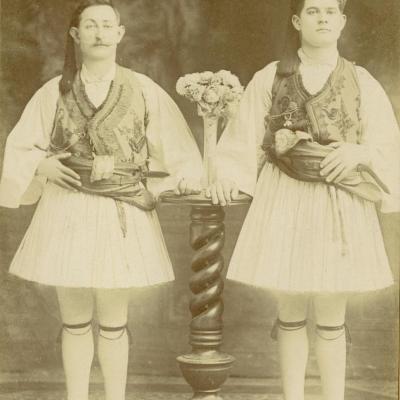
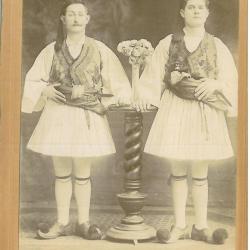
A black and white portrait of two men dressed in traditional Greek costume. The men are standing next to a wooden table, which has a vase of flowers on it. The background is a painted backdrop of a room. The men are both wearing a white pleasted skirt, white stockings with black bands below their knees which has tassels, black shoes with pompoms, entricately embroidered vests, and a white undershirt. They also have hats on which have long tassels on them.
Origin
Diane Frangos donated these photographs on behalf of her aunt, Angela Gatsos Demetrakakes, in memory of her maternal grandparents, Anthanasios Gatso and Ekaterina Makris Gatsos.
These two men are wearing traditional Greek costume. There are two main types of costumes for men. Foustanella and Vraka. In the central and southern regions of Greece wear the "fustanella". After the liberation of Greece in the first quarter of the 19th century, all male costumes in Peloponnesus took the form of the fustanella. Fustanella was worn by the Greek fighters of the 1821 revolution and today it serves as the official uniform of the Evzones, Greece's Presidential Guard. The fustanella skirt consists of 400 pleats symbolizing the years during which Greece was under Ottoman rule. The remainder of the costume is composed of a white shirt with very wide flowing sleeves, an embroidered woolen vest, a sash worn around the waist, and shoes (tsarouhia) with large pompons. The embroidery is made of spun wool and the belt is of a fine leather work. The Fustanella has changed in the meaning of detailed work, the length of the fousta, and, sometimes, the number of jackets worn. The sleeves have become decorative, resembling wings without the function of sleeves. After all the changes, it has become the standard Pan-Hellenic male costume used to the modern times. Extremely popular, this costume is now one of the world's most well-known traditional garments: Vraka The word vraka means generally the male Crete costume although this kind of trousers worn by the islands inhabitants of Greece instead of a fustanella. The men's costume is made of heavy wool felt to protect against the cold and is embroidered with black cord. In some island 'vraka' was worn by women too and was long, to the ankles, because during the Turkish occupation women wanted to hide their legs from the eyes of the Turks.
These two men are wearing traditional Greek costume. There are two main types of costumes for men. Foustanella and Vraka. In the central and southern regions of Greece wear the "fustanella". After the liberation of Greece in the first quarter of the 19th century, all male costumes in Peloponnesus took the form of the fustanella. Fustanella was worn by the Greek fighters of the 1821 revolution and today it serves as the official uniform of the Evzones, Greece's Presidential Guard. The fustanella skirt consists of 400 pleats symbolizing the years during which Greece was under Ottoman rule. The remainder of the costume is composed of a white shirt with very wide flowing sleeves, an embroidered woolen vest, a sash worn around the waist, and shoes (tsarouhia) with large pompons. The embroidery is made of spun wool and the belt is of a fine leather work. The Fustanella has changed in the meaning of detailed work, the length of the fousta, and, sometimes, the number of jackets worn. The sleeves have become decorative, resembling wings without the function of sleeves. After all the changes, it has become the standard Pan-Hellenic male costume used to the modern times. Extremely popular, this costume is now one of the world's most well-known traditional garments: Vraka The word vraka means generally the male Crete costume although this kind of trousers worn by the islands inhabitants of Greece instead of a fustanella. The men's costume is made of heavy wool felt to protect against the cold and is embroidered with black cord. In some island 'vraka' was worn by women too and was long, to the ankles, because during the Turkish occupation women wanted to hide their legs from the eyes of the Turks.
Rights and Reproduction
The content on this site is made available for research and education purposes only. The use of these materials may be restricted by law or the donor.
Any other use, such as exhibition, publication, or commercial use, is not allowed except by written permission in accordance with the NHM Image Rights and Reproduction Policy.
For questions on image rights and reproduction, please contact [email protected]
Any other use, such as exhibition, publication, or commercial use, is not allowed except by written permission in accordance with the NHM Image Rights and Reproduction Policy.
For questions on image rights and reproduction, please contact [email protected]
Citation
Photograph, National Hellenic Museum, https://collections.nationalhellenicmuseum.org/Detail/objects/4222. Accessed 10/14/26.