Object ID
2024.45.2
Object Name
Photograph
Date Created
1900
Donor
Vicki Cobb
Object Entities
Cobb, Vicki (collected by)
Anagnostopoulos, Panagiotis (Paiko) (subject)
Anagnostopoulos (Kakouri), Olga (subject)
Anagnostopoulos, Panagiotis (Paiko) (subject)
Anagnostopoulos (Kakouri), Olga (subject)
Related Items
Access Points
Object Description
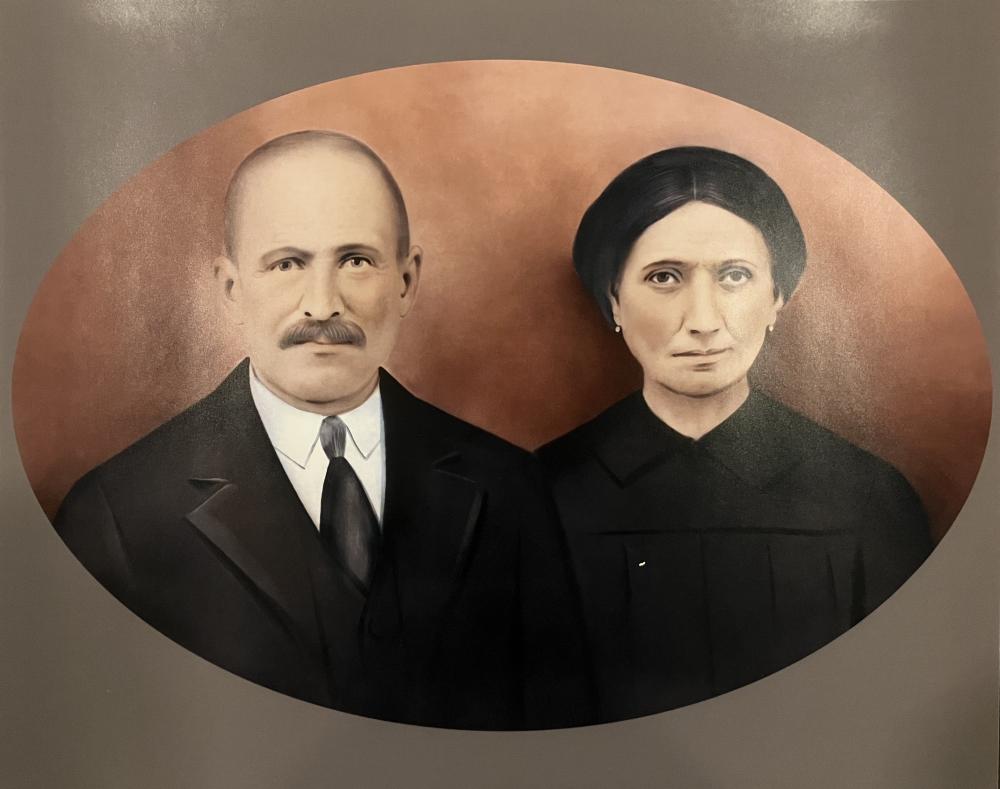
Color copy of a photograph adhered to canvas. A man and a woman are pictured from the chest up, standing next to each other.
Origin
The original hand-painted antique portrait of this couple began as a lightly printed black and white photograph that was painted over by an artist. The man is Panagiotis (Paiko) Anagnostopoulos (1863-1945) and Olga Anagnostopoulos (Kakouri) (1869-1954). The artist painted Paiko in great detail, but Olga was most likely painted by the assistant.
Paiko and Olga lived in Divritsa, a mountain village in the Peloponnese. In 1936, the village was renamed Dimitra. A Greek name was preferred to the Albanian derived "Divritsa," which means "a place with abundant water." Olga taught at the boys school that was located on the second floor of the Kakouri household, which had a beautiful open yard where the boys played at recess.
Paiko was a character, and according to legend, he was nicknamed Katsoufis, meaning "joyless." Another resident of Divritsa, George Stotis, recalled that Paiko was a money lender and referred to him as miserly. His descendants claimed that he was a tax collector. Furthering his muddy occupational history, a book written about Dimitra states that in 1920 Panagiotis Anagnostopoulos was a merchant: "...and further up on the same side of the street [Athenas Street] was Panagiotis Anagnostopoulos with his brothers. Their store was large and beautiful. They used to sell men's suits, caps, woolen undershirts from Maragozopoulos in Patra, Markezinis socks, red sashes for men, and cotton long johns." This excerpt is from a passage that identifies stores in the commercial areas of Divritsa in 1920. Paiko was 57 years old at the time.
Paiko and Olga had seven children - Vasiliki, George, Theodore, Antonia, Kalliopi, Marigo, and Aphrodite. In 1916, Paiko immigrated to the United States with two of his daughters, Antonia and Aphrodite. They stayed in a dwelling behind the home of their daughter Vasiliki and her husband Vasili in the South Bottoms of Sioux City, Iowa. According to the 1920 US Census, Paiko and both daughters worked at a packing house. In 1921, Paiko returned to Greece with his daughter, Aphrodite, and Antonia stayed behind.
In 1941 Paiko became blind. During the Second World War, the Nazis and Italian Fascists took his livestock, consisting of goats and sheep, as well as everything he owned. He died in 1945 at 82 years old and his wife, Olga, died nine years later at the age of 85.
Paiko and Olga lived in Divritsa, a mountain village in the Peloponnese. In 1936, the village was renamed Dimitra. A Greek name was preferred to the Albanian derived "Divritsa," which means "a place with abundant water." Olga taught at the boys school that was located on the second floor of the Kakouri household, which had a beautiful open yard where the boys played at recess.
Paiko was a character, and according to legend, he was nicknamed Katsoufis, meaning "joyless." Another resident of Divritsa, George Stotis, recalled that Paiko was a money lender and referred to him as miserly. His descendants claimed that he was a tax collector. Furthering his muddy occupational history, a book written about Dimitra states that in 1920 Panagiotis Anagnostopoulos was a merchant: "...and further up on the same side of the street [Athenas Street] was Panagiotis Anagnostopoulos with his brothers. Their store was large and beautiful. They used to sell men's suits, caps, woolen undershirts from Maragozopoulos in Patra, Markezinis socks, red sashes for men, and cotton long johns." This excerpt is from a passage that identifies stores in the commercial areas of Divritsa in 1920. Paiko was 57 years old at the time.
Paiko and Olga had seven children - Vasiliki, George, Theodore, Antonia, Kalliopi, Marigo, and Aphrodite. In 1916, Paiko immigrated to the United States with two of his daughters, Antonia and Aphrodite. They stayed in a dwelling behind the home of their daughter Vasiliki and her husband Vasili in the South Bottoms of Sioux City, Iowa. According to the 1920 US Census, Paiko and both daughters worked at a packing house. In 1921, Paiko returned to Greece with his daughter, Aphrodite, and Antonia stayed behind.
In 1941 Paiko became blind. During the Second World War, the Nazis and Italian Fascists took his livestock, consisting of goats and sheep, as well as everything he owned. He died in 1945 at 82 years old and his wife, Olga, died nine years later at the age of 85.
Rights and Reproduction
The content on this site is made available for research and education purposes only. The use of these materials may be restricted by law or the donor.
Any other use, such as exhibition, publication, or commercial use, is not allowed except by written permission in accordance with the NHM Image Rights and Reproduction Policy.
For questions on image rights and reproduction, please contact [email protected]
Any other use, such as exhibition, publication, or commercial use, is not allowed except by written permission in accordance with the NHM Image Rights and Reproduction Policy.
For questions on image rights and reproduction, please contact [email protected]
Citation
Photograph, 1900, National Hellenic Museum, https://collections.nationalhellenicmuseum.org/Detail/objects/14053. Accessed 09/12/26.