Object ID
1999.20.8
Object Name
Other Documents
Language
English
Donor
Mary Economidys
Object Entities
Related Items
Book, Address, 1999.20.1
Newspaper, 1999.20.2
Newspaper, 1999.20.3
Newspaper, 1999.20.4
Letter, 1999.20.5
Letter, 1999.20.6
Letter, 1999.20.7
Other Documents, 1999.20.9
Card, Membership, 1999.20.10
Newspaper, 1999.20.11
Newspaper, 1999.20.12
Clipping, Newspaper, 1999.20.13
Newspaper, 1999.20.14
Photocopy, 1999.20.15
Photocopy, 1999.20.16A
Photocopy, 1999.20.16B
Newspaper, 1999.20.17
Clipping, Newspaper, 1999.20.18
Newspaper, 1999.20.19
Letter, 1999.20.20
Letter, 1999.20.21
Letter, 1999.20.22
Letter, 1999.20.23
Letter, 1999.20.24
Letter, 1999.20.25
Letter, 1999.20.26
Letter, 1999.20.27
Letter, 1999.20.28
Letter, 1999.20.29
Letter, 1999.20.30A
Letter, 1999.20.30B
Clipping, Newspaper, 1999.20.31
Clipping, Newspaper, 1999.20.32
Photograph, 1999.20.33
Other Documents, 1999.20.34A
Other Documents, 1999.20.34B
Other Documents, 1999.20.34C
Other Documents, 1999.20.34D
Other Documents, 1999.20.34E
Other Documents, 1999.20.34F
Other Documents, 1999.20.34G
Other Documents, 1999.20.34H
Other Documents, 1999.20.34I
Other Documents, 1999.20.34J
Newspaper, 1999.20.35
Newspaper, 1999.20.36
Newspaper, 1999.20.37
Newspaper, 1999.20.38
Clipping, Newspaper, 1999.20.39
Clipping, Newspaper, 1999.20.40
Clipping, Newspaper, 1999.20.41
Clipping, Newspaper, 1999.20.42
Newspaper, 1999.20.2
Newspaper, 1999.20.3
Newspaper, 1999.20.4
Letter, 1999.20.5
Letter, 1999.20.6
Letter, 1999.20.7
Other Documents, 1999.20.9
Card, Membership, 1999.20.10
Newspaper, 1999.20.11
Newspaper, 1999.20.12
Clipping, Newspaper, 1999.20.13
Newspaper, 1999.20.14
Photocopy, 1999.20.15
Photocopy, 1999.20.16A
Photocopy, 1999.20.16B
Newspaper, 1999.20.17
Clipping, Newspaper, 1999.20.18
Newspaper, 1999.20.19
Letter, 1999.20.20
Letter, 1999.20.21
Letter, 1999.20.22
Letter, 1999.20.23
Letter, 1999.20.24
Letter, 1999.20.25
Letter, 1999.20.26
Letter, 1999.20.27
Letter, 1999.20.28
Letter, 1999.20.29
Letter, 1999.20.30A
Letter, 1999.20.30B
Clipping, Newspaper, 1999.20.31
Clipping, Newspaper, 1999.20.32
Photograph, 1999.20.33
Other Documents, 1999.20.34A
Other Documents, 1999.20.34B
Other Documents, 1999.20.34C
Other Documents, 1999.20.34D
Other Documents, 1999.20.34E
Other Documents, 1999.20.34F
Other Documents, 1999.20.34G
Other Documents, 1999.20.34H
Other Documents, 1999.20.34I
Other Documents, 1999.20.34J
Newspaper, 1999.20.35
Newspaper, 1999.20.36
Newspaper, 1999.20.37
Newspaper, 1999.20.38
Clipping, Newspaper, 1999.20.39
Clipping, Newspaper, 1999.20.40
Clipping, Newspaper, 1999.20.41
Clipping, Newspaper, 1999.20.42
Access Points
Object Description
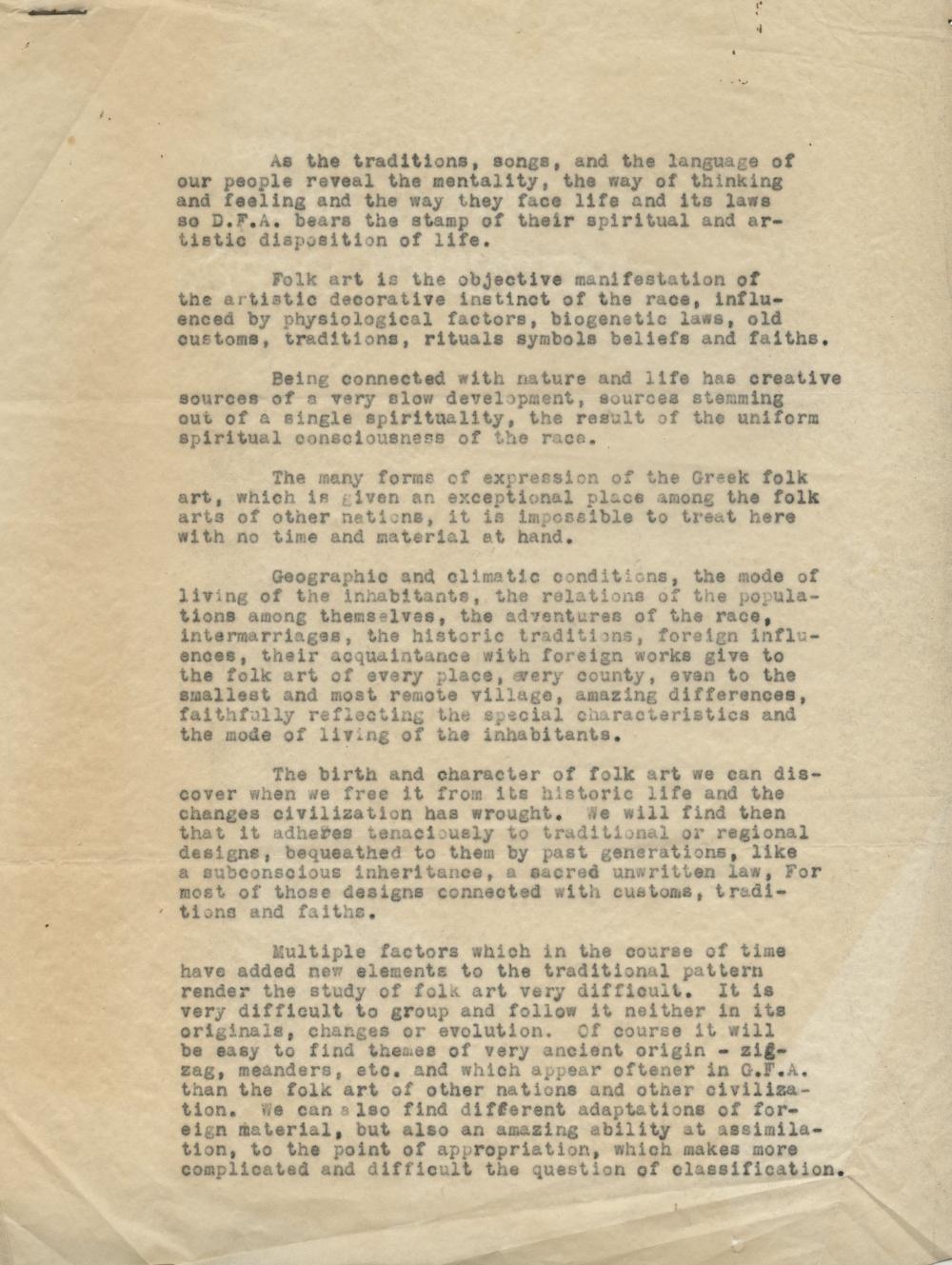
A aged, stapled, document with seven paragraphs typed in black ink. The paper itself, is thin and nearly transparent. The first paragraph reads,
"As the traditions, songs, and the language of our people reveal the mentality, the way of thinking and feeling and the way they faced life and its laws so D.F.A. bears the stamp of their spiritual and artistic disposition of life.
Folk art is the object manifestation of the artistic decorative instinct of the race, influenced by physiological factors, biogenetic laws, old customs, traditions, rituals symbols beliefs and faiths.
Being connected with nature and life has creative sources of a very slow development, sources stemming out of a single spirituality, the result of the uniform spiritual consciousness of the race.
The many forms of expression of the Greek folk art, which is given an exceptional place among the folk arts of other nations, it is impossible to treat here with no time and material at hand.
Geographic and climatic conditions, the mode of living among the inhabitants, the relations of the population among themselves, the adventure of the race, intermarriage, the historical traditions, foreign influences, their acquaintance with foreign works given to the folk art of every place, every country, even to the smallest and most remote village, amazing differences, faithfully reflecting the special characteristic and the mode of living of the inhabitants.
The birth and character of folk art we can discover when we we free it from its historical life and the changes civilizations has wrought. We will that it adheres tenaciously to traditional or regional designs, bequeathed to them by past generations, like a subconscious inheritance, a sacred unwritten law, For most of those designs connected with customs, traditions and faiths.
Multiple factors which in the course of time have added new elements to the traditional pattern render the study of folk art very difficult. It is very difficult to group and follow it neither in its originals, changes or evolutions. Of course it will be easy to find themes of very ancient origin-zig-zag, meanders, ect. and which appear oftener in G.F.A than the folk art of other nations and other civilization. We can also find different adaptations of foreign material, but also an amazing ability at assimilation, to the point of appropriation, which makes more complicated and difficult the question of classification."
"As the traditions, songs, and the language of our people reveal the mentality, the way of thinking and feeling and the way they faced life and its laws so D.F.A. bears the stamp of their spiritual and artistic disposition of life.
Folk art is the object manifestation of the artistic decorative instinct of the race, influenced by physiological factors, biogenetic laws, old customs, traditions, rituals symbols beliefs and faiths.
Being connected with nature and life has creative sources of a very slow development, sources stemming out of a single spirituality, the result of the uniform spiritual consciousness of the race.
The many forms of expression of the Greek folk art, which is given an exceptional place among the folk arts of other nations, it is impossible to treat here with no time and material at hand.
Geographic and climatic conditions, the mode of living among the inhabitants, the relations of the population among themselves, the adventure of the race, intermarriage, the historical traditions, foreign influences, their acquaintance with foreign works given to the folk art of every place, every country, even to the smallest and most remote village, amazing differences, faithfully reflecting the special characteristic and the mode of living of the inhabitants.
The birth and character of folk art we can discover when we we free it from its historical life and the changes civilizations has wrought. We will that it adheres tenaciously to traditional or regional designs, bequeathed to them by past generations, like a subconscious inheritance, a sacred unwritten law, For most of those designs connected with customs, traditions and faiths.
Multiple factors which in the course of time have added new elements to the traditional pattern render the study of folk art very difficult. It is very difficult to group and follow it neither in its originals, changes or evolutions. Of course it will be easy to find themes of very ancient origin-zig-zag, meanders, ect. and which appear oftener in G.F.A than the folk art of other nations and other civilization. We can also find different adaptations of foreign material, but also an amazing ability at assimilation, to the point of appropriation, which makes more complicated and difficult the question of classification."
Rights and Reproduction
The content on this site is made available for research and education purposes only. The use of these materials may be restricted by law or the donor.
Any other use, such as exhibition, publication, or commercial use, is not allowed except by written permission in accordance with the NHM Image Rights and Reproduction Policy.
For questions on image rights and reproduction, please contact [email protected]
Any other use, such as exhibition, publication, or commercial use, is not allowed except by written permission in accordance with the NHM Image Rights and Reproduction Policy.
For questions on image rights and reproduction, please contact [email protected]
Citation
Other Documents, National Hellenic Museum, https://collections.nationalhellenicmuseum.org/Detail/objects/13755. Accessed 10/12/26.